anthropology
introduce
Logfire supports an extra line of code to detect calls to Anthropic.
import anthropic
import logfire

client = anthropic.Anthropic()

logfire.configure()
logfire.instrument_anthropic(client)  # (1)!

response = client.messages.create(
    max_tokens=1000,
    model='claude-3-haiku-20240307',
    system='You are a helpful assistant.',
    messages=[{'role': 'user', 'content': 'Please write me a limerick about Python logging.'}],
)
print(response.content[0].text)
-
If you do not have access to the client instance, you can detect the
两者。人类学and人类学。AsyncAnthropicclasses by passing a class (for example,logfire.instrument_anthropic(anthropic.Anthropic)) or simply passing no parameters (i.e.,logfire.instrument_anthropic()).
For more information, see instrument_anthropic() API Reference.
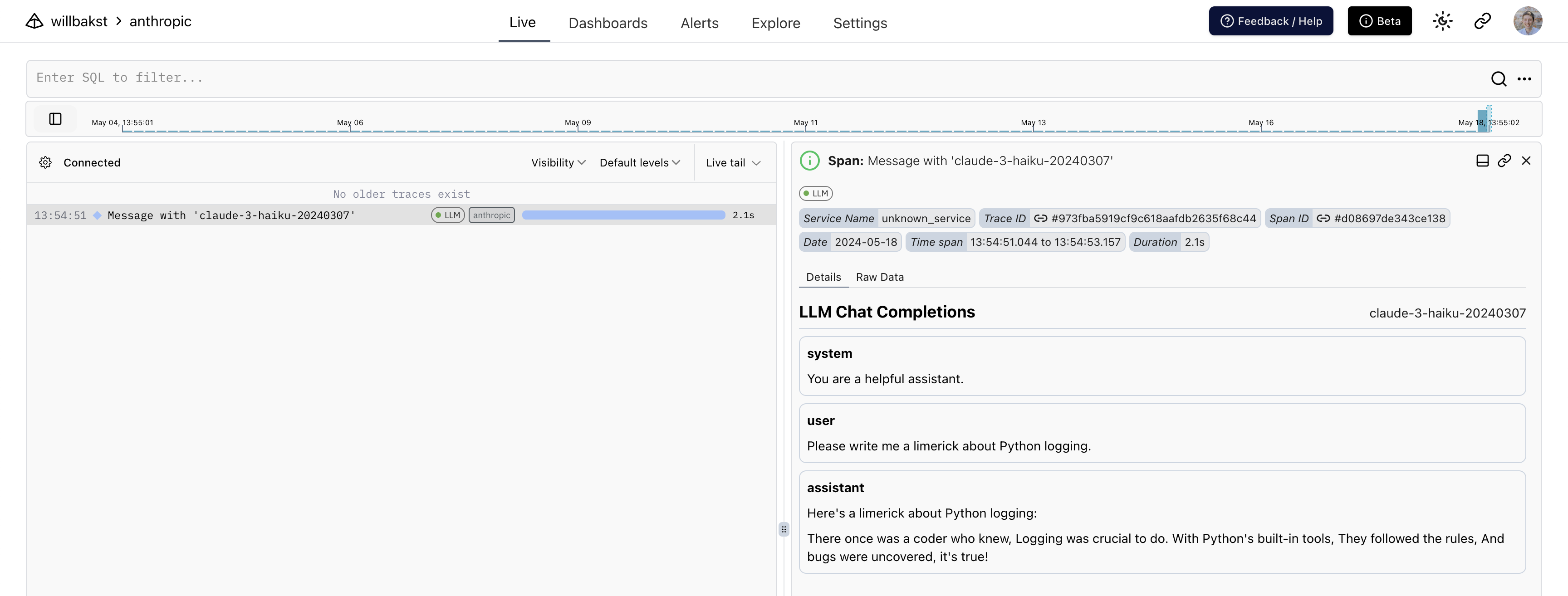
With it, you can get:
-
Span around calls to Anthropic that record duration and catch any exceptions that may occur
-
Human-readable display of conversations with agents
-
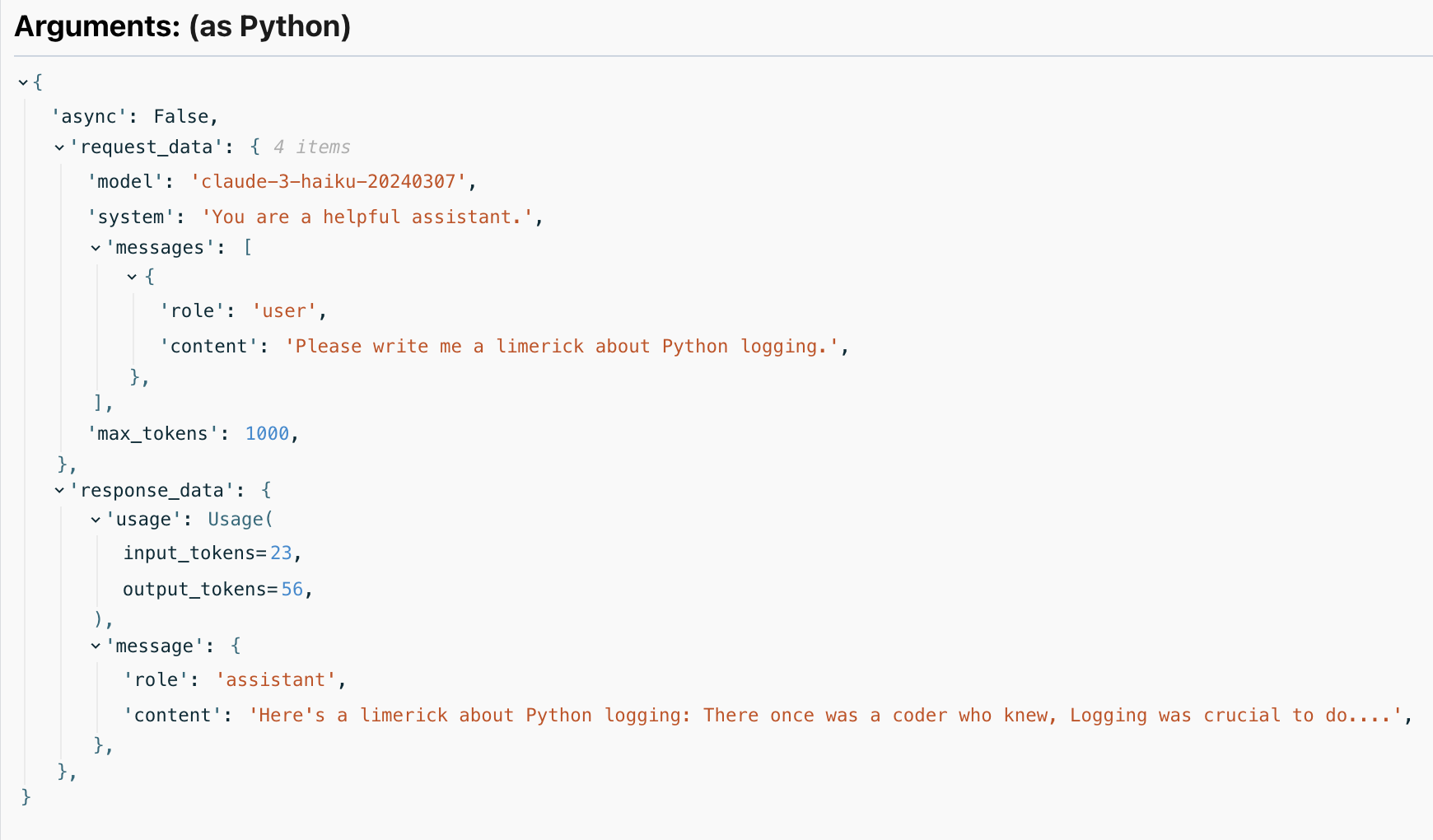
Details of the response, including the number of tokens used
the methods encompassed
The following anthropological methods are covered:
client.messages.createclient.messages.stream(客户端.messages.stream)client.beta.tools.messages.create
All methods cover 人为的方法。人类学 and 人类学。异步人。
streaming response
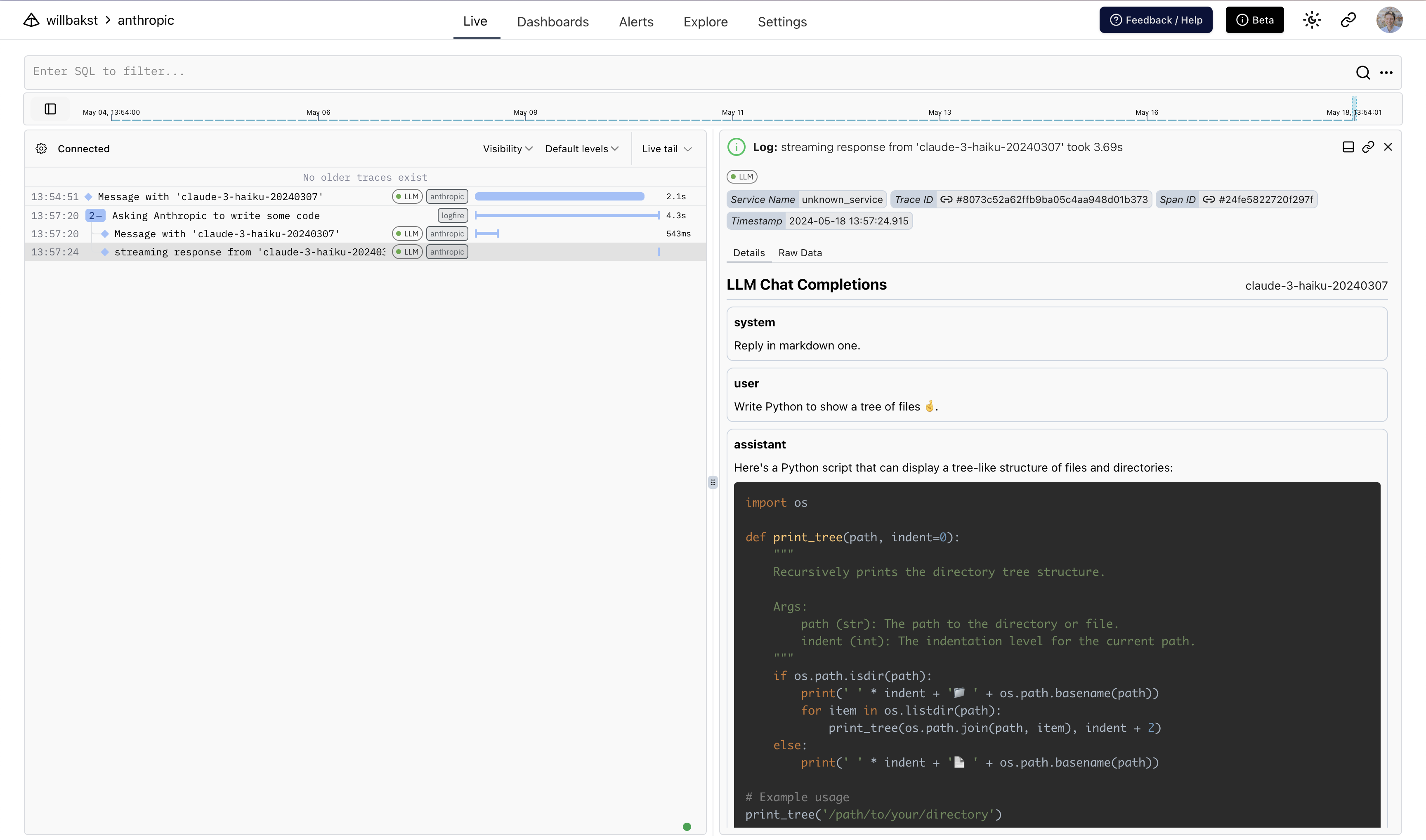
When detecting streaming responses, Logfire creates two spans-one around the initial request and one around the streaming response.
Here we also use Rich's Live and Markdown types to render responses in real time in the terminal.: Dancer:
import anthropic
import logfire
from rich.console import Console
from rich.live import Live
from rich.markdown import Markdown

client = anthropic.AsyncAnthropic()
logfire.configure()
logfire.instrument_anthropic(client)


async def main():
    console = Console()
    with logfire.span('Asking Anthropic to write some code'):
        response = client.messages.stream(
            max_tokens=1000,
            model='claude-3-haiku-20240307',
            system='Reply in markdown one.',
            messages=[{'role': 'user', 'content': 'Write Python to show a tree of files 🤞.'}],
        )
        content = ''
        with Live('', refresh_per_second=15, console=console) as live:
            async with response as stream:
                async for chunk in stream:
                    if chunk.type == 'content_block_delta':
                        content += chunk.delta.text
                        live.update(Markdown(content))


if __name__ == '__main__':
    import asyncio

    asyncio.run(main())
In Logfire it looks like this:
本文总阅读量次